
Most of my conversations about AI right now go the same way. Someone tells me how many of their people are using it, how many have been through training and how many agents they've built. Then I ask what it's done for productivity or ROI across the business, and the conversation goes quiet.
That isn't a training problem, and a lot of businesses are about to spend their 2027 budget as if it is. Knowing how to use AI and changing how a business actually works are two different things. The first is a skills issue. The second is a leadership issue, and hardly anyone is treating it like one.
Individual productivity isn't business productivity
Plenty of people are using AI really well in their own work. Someone in sales has automated their prospect research, someone in finance has built an agent to pull reports together, someone in marketing is producing content in half the time. All useful, but has the way those three teams work together changed at all?
If sales can now generate three times as many opportunities and the rest of the business can't handle them, you haven't improved anything. You've just moved the bottleneck.
I saw this with a marketing leader I coach. He came to me worried about what AI meant for his team. They'd taken to it brilliantly, rethinking their branding and how they talk to customers, but the rest of the business couldn't keep up. The extra activity wasn't turning into the sales everyone expected, his team felt held back, and the business had started to see it as a marketing problem.
Things changed when he stopped focusing on what AI could do for his team and started looking at how his team worked with sales. With sales and product, they connected their AI agents so sales could see exactly which pathway each lead came through. Marketing can now show what their work is actually producing, sales know how each lead found them, and the three teams are handling the extra volume together instead of marketing pushing more into a process that couldn't take it.
Nobody needed any additional AI training to get there. What changed was how those leaders thought about their own function and their responsibility to the rest of the business.
The same goes for the time people are saving. Is anyone asking where it's going? Is it being pointed at work that actually moves the business, or are people just producing more of what they were already producing?
The skills conversation is missing something
There's a new report on AI skills every week, and most of the people publishing them, me included, have a commercial interest in the answer. So it's worth looking at them together rather than one at a time.
McKinsey Global Institute's Skill Change Index, published in November 2025 as part of Agents, robots, and us: Skill partnerships in the age of AI, looks at how exposed different skills are to automation.
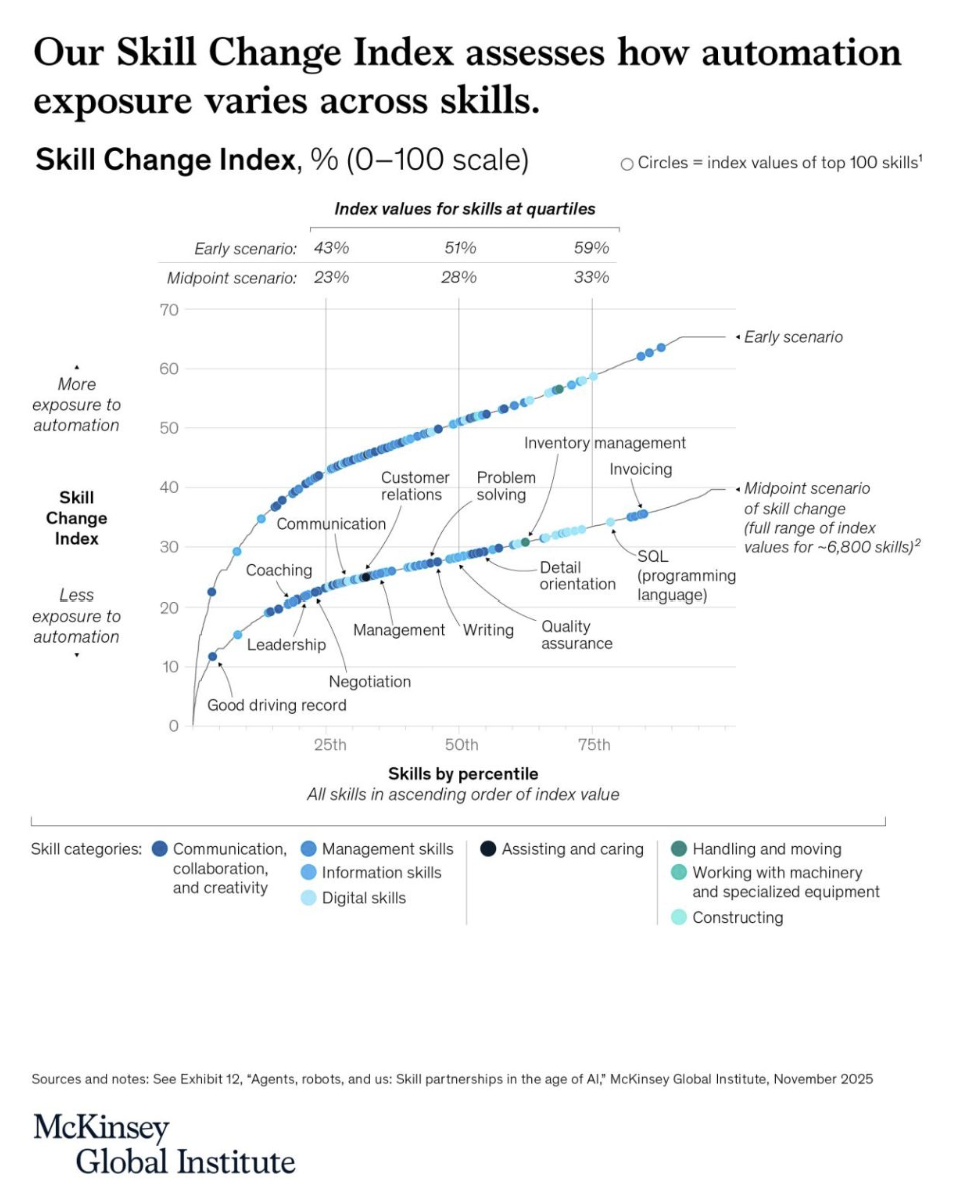
Leadership, coaching, negotiation and communication sit among the least exposed. That's usually read as good news for those skills. I read it the other way: the more automation there is everywhere else in the business, the better people need to be at all four. A skill being harder to automate doesn't mean the bar stays where it is.
Workhuman found that only 43% of employees say their leader helps them focus on the most important work. Mercer found that 52% of HR leaders in high-growth organizations believe managing teams of humans and AI will need leadership skills that aren't widely available today.
That 43% should worry anyone spending heavily on AI. If most people don't feel their leader helps them focus on what matters, why would we expect the time AI saves to go anywhere useful?
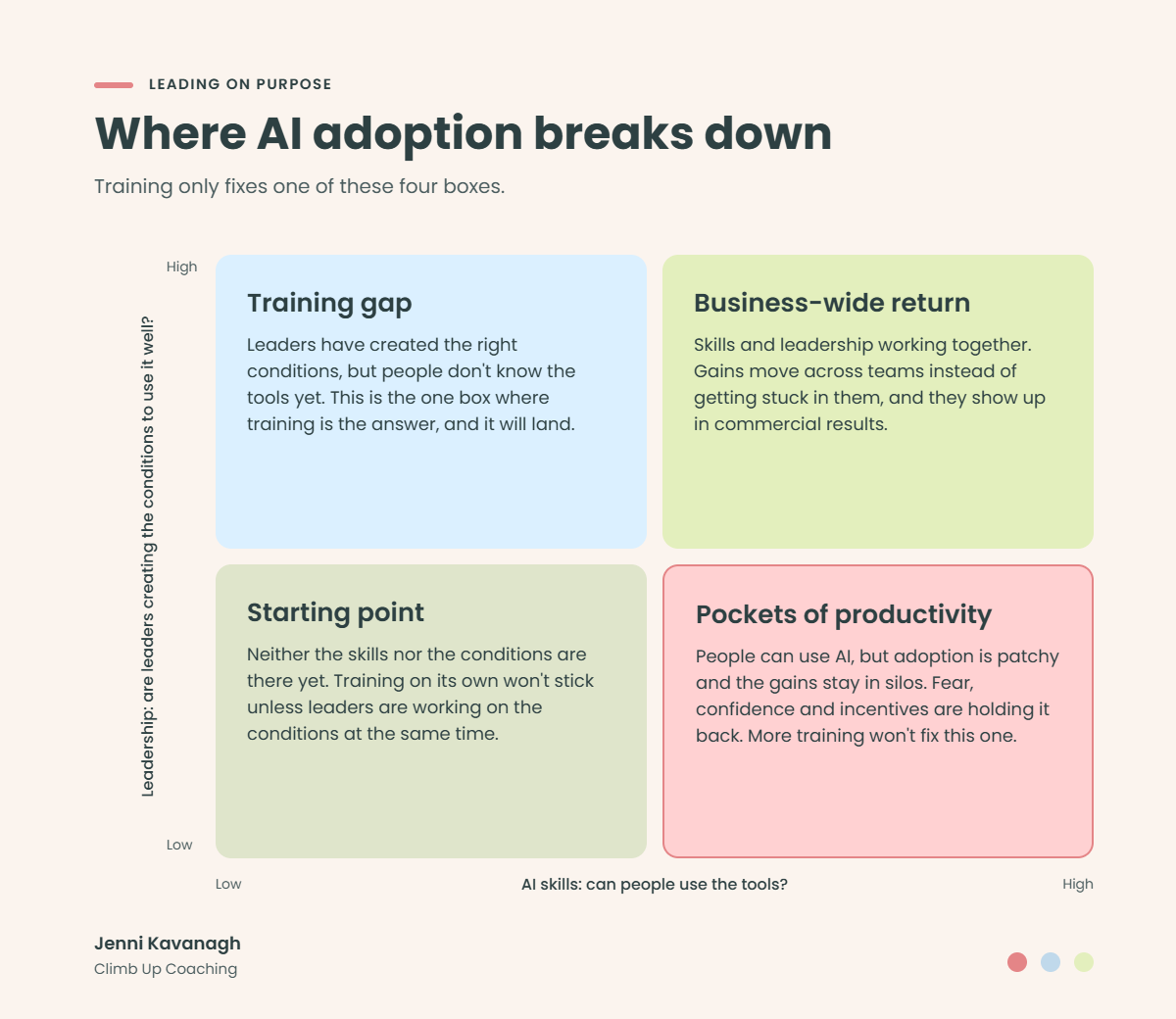
There are two leadership capabilities that need investment alongside AI training.
understanding why someone is or isn't adopting AI
We tend to assume that if someone isn't using AI, they don't understand it or don't know how. Sometimes that's true. A lot of the time it's more personal than that.
They might worry that showing how much of their job can be automated will put their job at risk. They might not have the confidence to experiment in front of colleagues. They might have spent 20 years becoming an expert in something that suddenly feels less valued. Or, and nobody talks about this enough, they might just enjoy the part of the job you're asking them to automate.
If someone went into marketing because they love writing, or into data science because they love solving hard problems, what happens to how they feel about their job when we automate that bit? We keep assuming everyone wants to free up as much time as possible without asking what they'd actually like to free it up from.
Then there's the reward problem. If getting more efficient just earns someone more work, or they watch colleagues lose their jobs, why would they share what they've figured out with anyone?
Getting people to tell you what's really going on takes trust. It takes a leader who can listen without judging, ask better questions and resist jumping straight to a fix. How many leaders have actually been taught to do that?
You can't send someone on a course to fix a fear you don't even know they have.
getting leaders to think beyond their own patch
For years we've given leaders a function, a budget and a set of targets, and judged them on how their own team performs. It shouldn't surprise anyone that AI adoption is happening in silos, since that's exactly how we set organizations up to work.
Now we're asking those same leaders to redesign workflows across functions, decide what AI should be deciding, work out where human judgment is still needed and figure out who's accountable once it all changes.
If four departments share a workflow, who gets the final say on how it runs? What happens when a change that's good for the business hurts one department's KPIs? If an agent's recommendations shape decisions across several teams, who's allowed to challenge it, who can override it and who owns the outcome? How many leadership teams have actually sat down and worked through those together?
Having run teams across a global business myself, I know how hard it is to look past your own numbers when your numbers are what you're paid on. It takes a broader understanding of the business, the ability to have awkward conversations with peers, a willingness to give up some control and the confidence to make calls without all the information. We need to build those capabilities in our leaders, and be honest about whether their targets and incentives even let them lead this way.
what are you investing in for 2027?
If you're setting your AI budget for next year, answer these five questions first:
Do your leaders actually know why adoption is stronger in some teams than others, or are they guessing?
Can they have real conversations with people about their concerns, motivations and changing roles?
Do you know whether the individual productivity gains you're seeing are turning into commercial outcomes?
Have you decided where decision-making and accountability sit as workflows change across departments?
Are you developing and rewarding leaders for doing what's best for the whole business, not just their own function?
This isn't an argument for less AI training. It's an argument for not expecting training to fix problems that belong to leadership. If you want people to change how they work, and you want that to show up in the business, you need to be as deliberate about developing your leaders as you are about your technology.
The businesses that treat their AI strategy and their leadership strategy as one conversation are the ones that will see the return.
If increasing AI adoption and getting a better return on your AI investment are priorities for 2027, let's talk about what you're doing right now to equip your leaders to deliver on that.
I work with organizations to build the leadership capability that drives adoption within teams, breaks down silos and turns individual productivity gains into commercial outcomes for the wider business. If that's something you're struggling with, or you want outside support as you put your AI strategy into action next year, let’s set up a call.